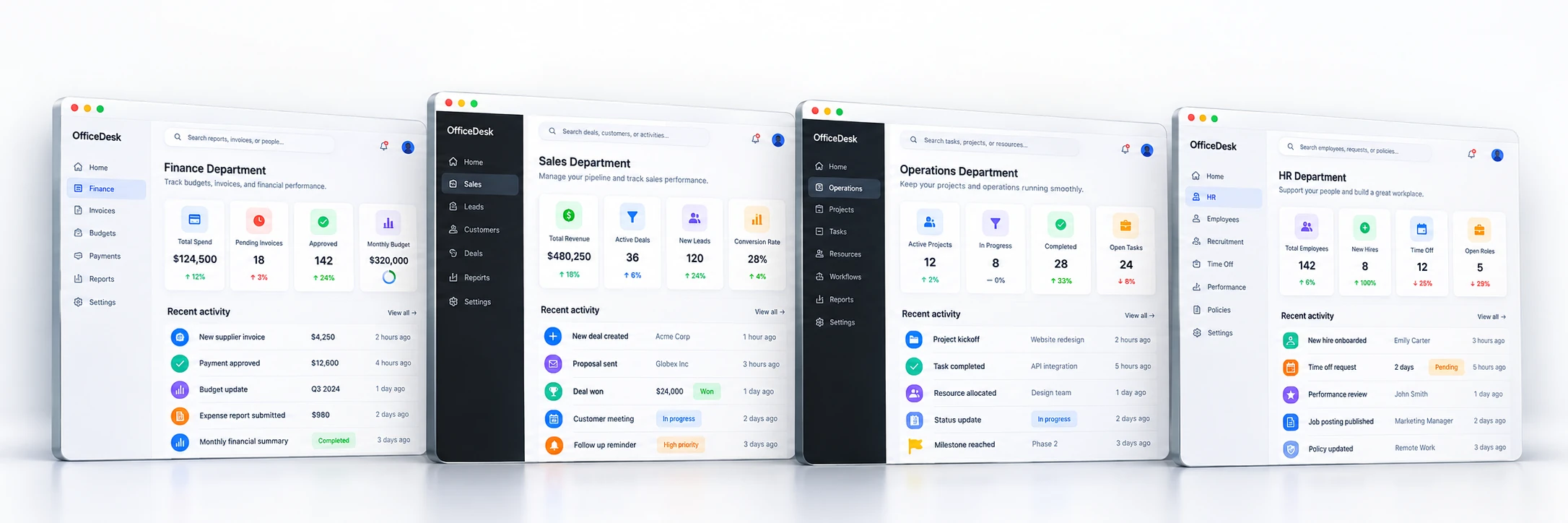
An AI office sounds simple; standing one up is not. OfficeDesk.ai lets you assemble departments of specialist AI support that work alongside your team, inside the tools you already use. One instruction in, one coordinated outcome out.
Each department runs like a real team: a manager that owns the outcome and the specialist agents it delegates to. You give one instruction; they coordinate the rest and report back for your approval. Switch between departments below, from ready-made templates to teams you build yourself.
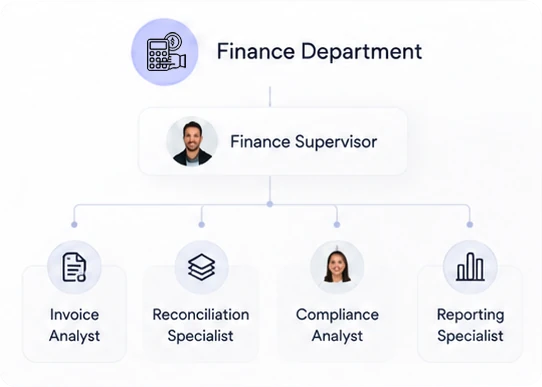
Keep the books current with a structured finance team. A Finance Manager owns the monthly close while leads run bookkeeping, payables, receivables and compliance.
Finance Manager
Owns the monthly close, triages incoming finance work, and delegates each part to the right team.
Bookkeeping Lead
Keeps the ledger current and delegates reconciliation and day-to-day bookkeeping.
Reconciliation Agent
Matches bank activity against the accounting system and flags exceptions for review.
Ledger Agent
Categorises transactions and posts routine journal entries.
Accounts Payable Lead
Owns money going out and delegates invoice capture and payments.
Invoice Processing Agent
Extracts supplier invoices and matches them to purchase orders.
Payment Agent
Schedules approved payments and reconciles them once they clear.
Accounts Receivable Lead
Owns money coming in and delegates billing and collections.
Billing Agent
Raises and sends customer invoices from agreed terms.
Collections Agent
Chases overdue accounts and reconciles incoming receipts.
Compliance Lead
Owns tax and reporting and delegates filings and month-end statements.
Tax Agent
Prepares GST and VAT workings and flags filing deadlines.
Reporting Agent
Builds management reports and month-end financial statements.
Ship software with a structured engineering team. A Project Manager drives delivery while the Tech Lead directs coding agents.
Project Manager
Triages incoming product and engineering work, delegates to the right specialists, and reports progress back up.
Tech Lead
Breaks technical work into implementable subtasks and assigns engineering work to the team.
Full-Stack Engineer
Implements new product features across APIs, UI and tests, then reports completed changes.
Full-Stack Engineer II
Fixes defects, refactors unstable areas, improves performance and hardens existing systems.
DevOps Lead
Owns delivery and reliability, and delegates release and infrastructure work to its team.
Release Engineer
Cuts releases, manages versioning and rollout, and rolls back on failure.
Infrastructure Agent
Provisions cloud infrastructure as code and keeps environments in sync.
Code Review Lead
Owns code quality, and delegates security and standards reviews to its team.
Security Reviewer
Audits changes for vulnerabilities, secrets and unsafe dependencies.
Standards Reviewer
Checks style, conventions and lint rules, then requests changes.
QA Lead
Owns quality assurance, and delegates test automation and regression checks to its team.
Test Automation Agent
Builds and maintains automated end-to-end and unit test suites.
Regression Tester
Re-runs suites on each change and reports regressions before release.
Drive growth with a coordinated marketing team. A Marketing Manager owns the outcomes while leads run content, analytics and social.
Marketing Manager
Owns growth outcomes, triages campaigns, and delegates work to content, analytics and social.
Content Lead
Owns the content pipeline and delegates copy and search optimisation.
Copywriter Agent
Drafts landing copy, emails and ad variations from a brief.
SEO Agent
Researches keywords and optimises pages for search.
Analytics Lead
Owns measurement and delegates reporting and insight.
Reporting Agent
Pulls campaign metrics into scheduled dashboards.
Insights Agent
Spots trends and recommends where to spend next.
Social Media Lead
Owns social presence and delegates scheduling and community.
Scheduling Agent
Plans and publishes posts across channels.
Community Agent
Monitors mentions and drafts replies for your review.
Research, write and ship posts with a small editorial team. A Managing Editor owns the calendar while leads run research, editorial and publishing.
Managing Editor
Owns the editorial calendar, triages topics, and delegates research, writing and publishing.
Research Lead
Owns topic research and delegates sourcing and fact-checking.
Topic Research Agent
Finds angles and builds outlines backed by sources.
Fact-Check Agent
Verifies claims and citations before drafting begins.
Editorial Lead
Owns drafting and delegates writing and copy-editing.
Draft Writer Agent
Turns approved outlines into full drafts.
Copy Editor Agent
Edits for clarity, tone and house style.
Publishing Lead
Owns publishing and delegates formatting and release.
SEO Formatter Agent
Adds metadata, headings and internal links.
Publishing Agent
Schedules and pushes posts live to the CMS.
Resolve customer messages with a coordinated support team. A Support Manager owns response times while leads run the shared inbox, escalations and help content.
Support Manager
Owns response times, triages incoming messages, and delegates each case to the right team.
Inbox Lead
Owns the shared inbox and delegates triage and replies.
Triage Agent
Categorises and routes incoming tickets by topic and urgency.
Reply Draft Agent
Drafts responses from past threads for your review.
Escalations Lead
Owns complex cases and delegates routing and follow-up.
Escalation Agent
Routes hard issues to the right owner in Slack.
Follow-up Agent
Chases open tickets until they are resolved.
Knowledge Lead
Owns help content and delegates articles and handoffs.
Knowledge Base Agent
Keeps help articles current from resolved tickets.
Handoff Agent
Summarises context when a case goes to a human.
Run people operations with a coordinated HR team. An HR Manager owns the employee experience while leads handle onboarding, records and internal comms.
HR Manager
Owns the employee experience, triages requests, and delegates each part to the right team.
Onboarding Lead
Owns new-hire setup and delegates paperwork and scheduling.
Document Collection Agent
Gathers and files new-hire documents.
Scheduling Agent
Books orientation and first-week sessions.
Records Lead
Owns employee records and delegates updates and contracts.
Records Agent
Keeps employee records current in your sheets.
Contract Prep Agent
Prepares offer letters and contracts from templates.
Comms Lead
Owns internal comms and delegates announcements and answers.
Announcements Agent
Drafts and sends team updates.
Policy Q&A Agent
Answers common HR questions from your handbook.
From your first department to approving the finished work, building your AI office is always the same four steps.
Start from a ready-made template, Finance, Tech, Marketing or Blog Publishing, or a blank Custom department. Each one arrives with a manager that coordinates the work, so the workspace mirrors how your business is organised.
Give each department the specialist agents its work needs, then switch on the skills each one uses, from inbox monitoring to document extraction and reporting. Connect the tools they run in, like Xero, QuickBooks, Gmail and Slack.
Hand over tasks, whole processes and the files that go with them, in plain language. A supervisor coordinates the work end to end while each department carries out its part across your connected tools.
Everything reports back to you, reviewable and traceable. Approve what matters, keep full visibility on what is happening, and refine over time. You supervise; the manual work is handled.
Open the workspace and add a department from a ready-made template or a blank canvas. Each one lands with a manager already in place, ready to coordinate the agents you add next.
Document intake, payables, receivables, reconciliation, compliance and reporting.
A Project Manager drives delivery while the Tech Lead directs coding agents.
Agents for content, analytics and social media to drive growth.
Research, draft, review and publish posts with a small editorial team.
Start from scratch with just a manager and build the team yourself.
Add the specialist agents each department needs, then switch on the skills they use, from monitoring an inbox to extracting documents and building reports. The manager delegates to them and reports back to you.
Communication
Documents & storage
Hand over a task, a whole workflow, and the files that go with it, in plain language. Each department picks up its part across your connected tools and keeps the work moving.
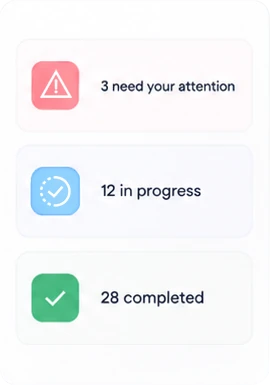
Watch the work land in a live activity feed, reviewable and traceable. Approve what matters, keep full visibility, and refine over time. You supervise; the manual work is handled.
The fastest place to feel the difference is finance. OfficeDesk.ai reconciles your bank activity and keeps your books current, so the monthly close stops being a scramble.
The Reconciliation Agent matches transactions against your accounting system and flags what needs a human decision, continuously rather than once a month.
Categorisation and routine entries are handled in Xero or QuickBooks as activity comes in, so your numbers are ready when you need them.
Anything ambiguous comes to you with the context to decide quickly. The AI does the legwork; the judgement stays yours.
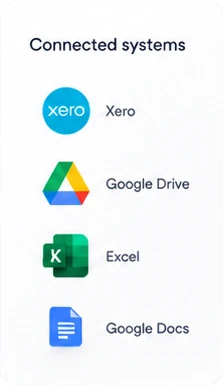
Your AI-powered departments connect to your existing stack rather than asking you to move your data somewhere new.
OfficeDesk.ai is an AI-powered operations team that works alongside your own. Instead of one general chatbot, it runs specialised, department-based AI support, supervised by you, that connects to the tools your business already uses and carries out the routine back-office work.
You hand a task to the AI supervisor. It breaks the work down, delegates each part to the department that owns it, the work is carried out across your connected tools, and the results report back up for your review. One instruction in, one coordinated outcome out.
OfficeDesk.ai connects to the SaaS tools businesses already run on, including Xero, QuickBooks, Gmail, Outlook, Slack, Google Drive and Sheets, Jira and Dropbox. Your AI-powered departments work inside these tools, so there is nothing to migrate.
The flagship workflow is autonomous bookkeeping and bank reconciliation. OfficeDesk.ai reconciles transactions and keeps your books current, with a human sign-off wherever you want one, so finance stops being a weekly scramble.
Yes. You supervise. Your AI-powered operations team does the manual heavy lifting while you review updates and approve anything that matters. Every action is logged and traceable in a transparent activity history.
Take the two-minute AI Operations Assessment to see which workflows fit your business, or start a free trial and connect your first tool.
Take the two-minute AI Operations Assessment for a tailored readiness score and matched workflows, or start your free trial and connect your first tool.